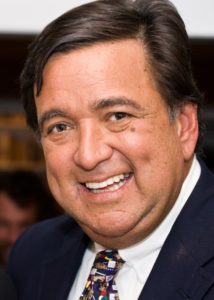
For a report on Governor Richardson from Conservation Voters New Mexico, CLICK HERE

The LCV Scorecard provides objective, factual information about the most important environmental legislation considered and the corresponding voting records of all members of Congress. It represents a consensus of experts from more than 20 respected environmental and conservation organizations who selected the key votes on which members should be graded. Scores are calculated on a scale of 0 to 100 based on the number of pro-environment votes cast out of the total number measured. Absences are counted as a negative vote. To view the 2006 scorecard, please click here.

The last six years of Bill Richardson’s LCV scores are above, followed by his lifetime LCV score. The lifetime LCV score represents the career average for all years served in office. For more about the Environmental Voting Record click here.

Environmental Overview

What accomplishments or experiences would you cite as influences on your approach to environmental or conservation issues? These may be professional or personal.

"When I first came to Congress, I worked with the Taos Pueblo to make my first major policy achievement the protection of a sacred area that had been controversial for years. It took a real commitment and lots of elbow grease working with the Pueblo and national conservation organizations – and the results, 25 years later, prove the importance of the action and the soundness of the decisions. I work with people who are knowledgeable and committed throughout the conservation movement and have been proud not only to sit at the table, but also even to serve in their leadership when asked and available. My approach in Congress, at the United Nations, as Energy Secretary, and as NM Governor has been to include voices for conservation, to listen to them, and to take action – not make broad undefined commitments or to take the middle or easy way out. My goal of changing the western energy dialogue has been fulfilled by hard work and persistence. I have stood up to entrenched interests in-state and out-of-state. I have voiced my opposition to the Bush Administration (often before anyone else) on issues from New Source Review to roadless areas to proposed oil and gas leasing in sensitive areas. I have made conservation commitments and kept them, funding new land and water conservation efforts in New Mexico, voicing support for restoration of the Mexican Wolf and the silvery minnow (despite strong political opposition), rejecting large industry donors who asked for favors against the public interest."

Global Warming & Energy priorities for first 100 days

As you know, a common rubric for measuring the results of a new presidential administration is to evaluate priorities for its first 100 days in office. The League of Conservation Voters believes that the one issue area voters will be most focused on, when it comes to the environment, is energy and global warming. If you are sworn in as the 44th President of the United States, what will be your priorities in the energy and global warming arena for your first 100 days in office, and why? These may be achievable by executive action, legislative action, international action, or appointments.

"On my first day in office, I’d end the war in Iraq. On my second day, I’d announce a plan for achieving national energy independence. When I rolled out my energy and climate policy earlier this month, I promised to lead a “second ‘first 100 days’” (without having seen this questionnaire) and saying that I would submit a significant set of policy recommendations to Congress to enact the boldest, most comprehensive, and most integrated energy and climate policy package offered by any presidential candidate. I will want the conservation community’s input in designing a two-day White House Summit on low- and no-petroleum vehicles to be held in my first 30 days in office. The primary new measures will include:

* Reduce oil demand up to 50% by 2020 by 1) getting plug-in cars into the marketplace, at 50% of new sales by 2020 with large rebates for buyers, while sharply reducing electric sector global warming pollution; 2) enacting a 50 mpg fuel economy standard for non-electric cars and trucks by 2020; and 3) implementing a 30% reduction in aggregate transportation/liquid fuels carbon emissions by 2020, with a collateral requirement that 10% of liquid fuels will come from low-carbon (fuel-cycle) sources by 2020 – same as the European Union is about to adopt. Further reductions in non-auto transportation and other industry oil use will further reduce demand by about 20% before 2020.

* Implement strong new measures for renewable energy and energy productivity in the natural gas and electrical sectors by 1) adopting a 30% RPS by 2020, and 50% by 2040; 2) enacting a statute requiring electricity providers and industrial users to increase energy productivity (efficiency) by 20% before 2020; 3) putting in place a new low-carbon electricity standard that forces all new plants to meet the same emissions profile as advanced natural gas by 2010, and 90%+ by 2020; 4) adopt new green building requirements and incentives.

* Reduce greenhouse gas emissions by at least 20% by 2020, 50% by 2030, 80% by 2040, and 90% by 2050 by 1) adopting auction-based cap and trade for the utility and industry sectors with 2% annual reductions 2010-2020 and 3% per year till 2040; 2) implementing the transportation sector improvements listed above; 3) pushing for international agreement with mandatory emissions limits keeping atmospheric CO2 below 450 ppm, along with collaborative financing of the small incremental cost of “doing it right” in developing nations; 4) funding for programs to protect low-income and vulnerable populations; 5) sequestration research and policy to allow sequestration in safe, predictable ways within five years after I take office.

* Strengthen science and technology. In this area we could really surprise ourselves and exceed the baseline emissions reductions and oil demand reductions predicted by my policy suggestions. We need to keep investing in this area, in close collaboration with entrepreneurs, inventors, and investors.

* Lead by example: Everything we do at home should be leveraged into international policy. I will immediately go back to the international negotiating table. I will restore bilateral partnerships with other nations that want to implement new technologies and efficiencies and control greenhouse gas emissions. I will get the North American Energy Council going not only to push for regional carbon trading but also to bring renewables and efficiency to market. I will work with our allies, oil-consuming nations, Gulf nations, and members of the UN Security Council to provide multilateral defense of key oil transportation routes such as the Straits of Hormuz, perhaps even assigning some of the costs to national oil companies and private oil companies that benefit from our defense expenditures on their behalf. I will implement a new, coordinated, international energy and climate policy, and America will return to international leadership on these issues.

No other candidate has the record, the experience, the vision, and the integrated/comprehensive action plan for achieving as much. I drafted the “slow, stop and reverse” policy resolution adopted, against anyone’s predictions, by the Western Governors’ Association. I authored, and brought Governor Schwarzenegger on board to support, massive shifts in WGA energy policy, including the biggest single project in WGA history, dedicated to renewables and energy efficiency and changing the energy dialogue in the West. As NM Governor, I have committed to strong new provisions such as the California car standards, specific, aggressive GHG reduction targets, strong new efficiency measures, the protection of public lands from Otero Mesa to the Valle Vidal (and beyond NM borders). As Energy Secretary I pushed for 80 mpg vehicles, adopted the strict new appliance and efficiency standards opposed by Administration economists and the industry and litigated for three years (unsuccessfully) by the Bush Administration, and got the President to support a much stronger RPS.

My first 100 days will be positively amazing."

Please respond to the previous question but focus on environmental issues outside of the energy and global warming arena.

"I am deeply concerned about the Clean Water Act, which needs updating and improvement to protect public water supplies. I believe the Bush Administration has distorted the CWA and the Clean Air Act, and I will immediately reverse interpretations and precedent that have weakened these important laws. I will fully fund the Land and Water Conservation Fund. I will propose Wilderness for the Arctic National Wildlife Refuge. I will enact provisions of the 2000 Roadless Conservation rule, which I supported as Governor of New Mexico both inside NM and at the Western Governors’ Association. I will also support important changes to implement environmental justice standards throughout the federal agencies. Last, my appointments will bring strong new voices for conservation before the Congress for approval, and my White House will be structured to support and engage environmental initiatives, much as I have done in the Governor’s Office in New Mexico, where we have started a whole new era in an energy/coal/oil and gas state." 

Priority compared to other issues for first 100 days

Many candidates for office, not just for president, intend or promise to do great things on many issues. How would you say environmental or conservation issues would rank as a priority for you in your first 100 days when compared to other issues? Why? Do you intend to personally attend to these issues?

"After bringing home the troops, my top priorities are energy and climate, and health care. It is also critical to expand and develop our protections against terrorism and protect the national security and safety of the American people, but this will be a less-visible initiative. As mentioned above I will hold a White House Summit on auto technologies in the first month, I will make good appointments an early and high priority, and I will use the bully pulpit (TR) and the first 100 days (FDR) to make the American public aware that we are now engaged in problem-solving and positive policy on energy and climate, and the environment. I have shown not only the willingness to lead this way in New Mexico and the West, but every inclination to do so, despite the political conditions I saw when I took office in early 2003. My record proves it. I am not making speeches on the Senate floor, or taking positions in reaction to bills. I am actually making these things happen, on the ground. For instance, the Western Regional Climate Action Initiative has been a major goal for me and we are getting it done now with AZ, CA, OR, UT, and WA. I believe in action, not words. I have called on the American people and Congress to support an energy and climate revolution. Revolutions are composed of action, not planning. We are going to make change during my first four years – way faster than others are proposing it – because we must change fast, or sink slowly. If we don’t act fast, we could easily end up falling back into old habits, allowing the scions of the status quo to stall and stop needed changes. That will not happen in a Richardson Administration. My view is that Apollo metaphors are cheap and easy UNLESS they create real change and action within the decade – as JFK did when he proposed putting someone on the moon. Big research funds and technology research are not the solution. Policy itself must change."  

Return to Top | Return to Home Page | Donate to LCV | Sign Up for Action Alerts | Visit LCV.org
Complete Bill Richardson Questionnaire (.PDF) | More About This Project